
Commercial wheelchair lifts
Commercial inclined platform lifts: a wheelchair lift that rides the stairs
When there is no floor space beside a staircase for a vertical lift and no budget for an elevator, an inclined platform lift carries the wheelchair up the stair itself on a rail, then folds flat against the wall so the stair stays open for everyone else. We install the Savaria Delta in commercial buildings across central Pennsylvania and northern Maryland and handle the state permit and witnessed inspection on each one.
What an inclined platform lift is
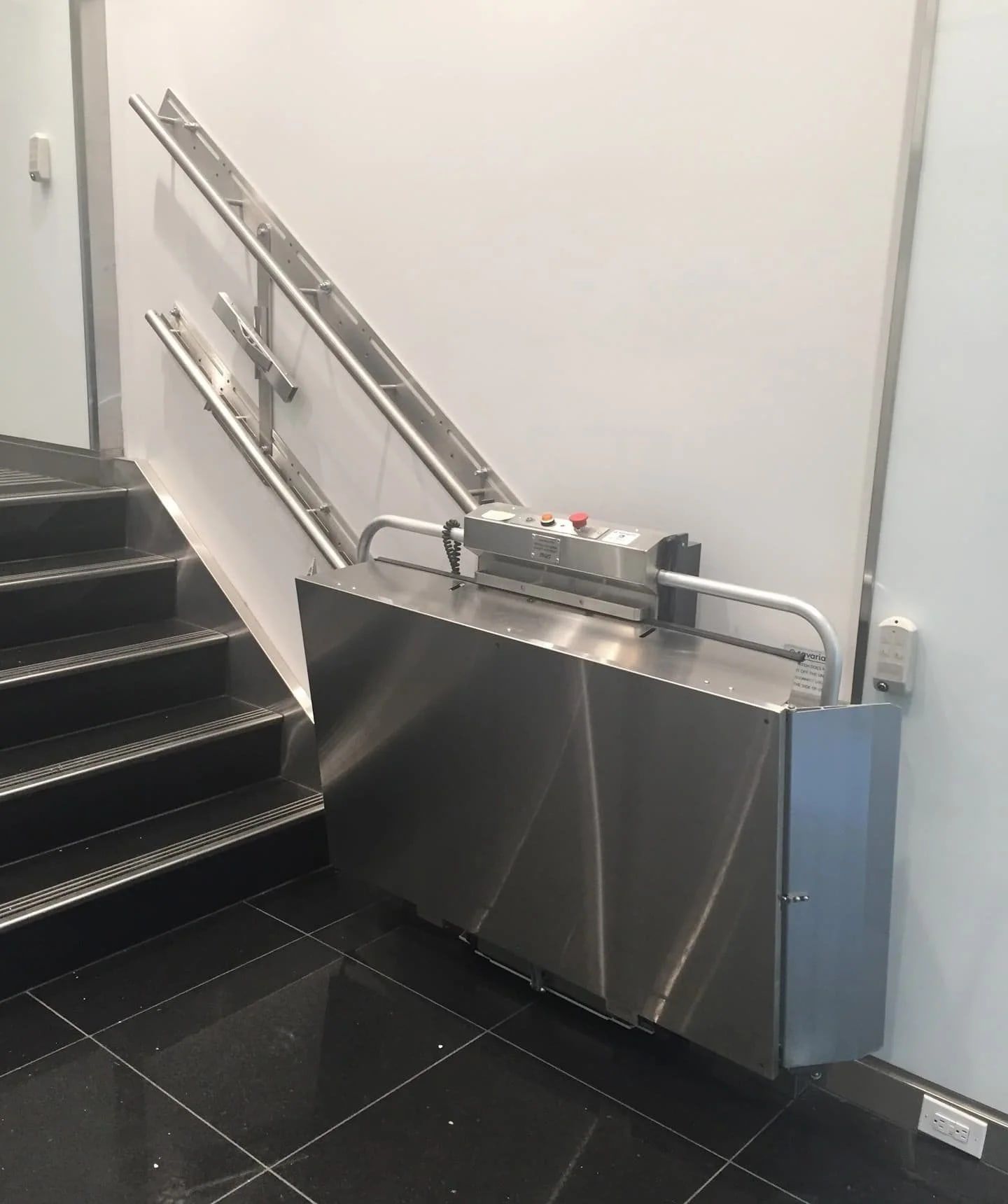
A vertical platform lift moves straight up in its own footprint. An inclined platform lift mounts a rail along a staircase and runs a folding platform up and down that rail, the way a stairlift carries a seat, but sized and rated for a rider who stays in the chair. The platform, its side arms, and the loading ramps fold against the wall when parked, so the stair keeps most of its width for walking traffic and for egress.
The lift we install is the Savaria Delta: 550 lb capacity with a 660 lb option, up to 80 feet of rail on a single straight flight of constant slope, 15 to 20 feet per minute, battery powered with charging at the parking points so it keeps running through a power outage. Entry is straight through or at 90 degrees. A motorized fold and call stations at each landing are available, along with a weather-resistant finish for a covered or moderate outdoor stair.
Why buildings choose us for an inclined lift
We measure the stair first
Clear width when folded, landing space, slope, and rail support are checked before any recommendation. If the stair will not pass, we say so and show the vertical option.
Straight answers on fit
The Delta is a straight-stair lift. We do not force it onto a stair with a turn; we find the lift that actually fits.
Permit, test, service
State permit before the order, witnessed acceptance test, and flat-rate service with plans that include the periodic tests.
Commercial lifts in place
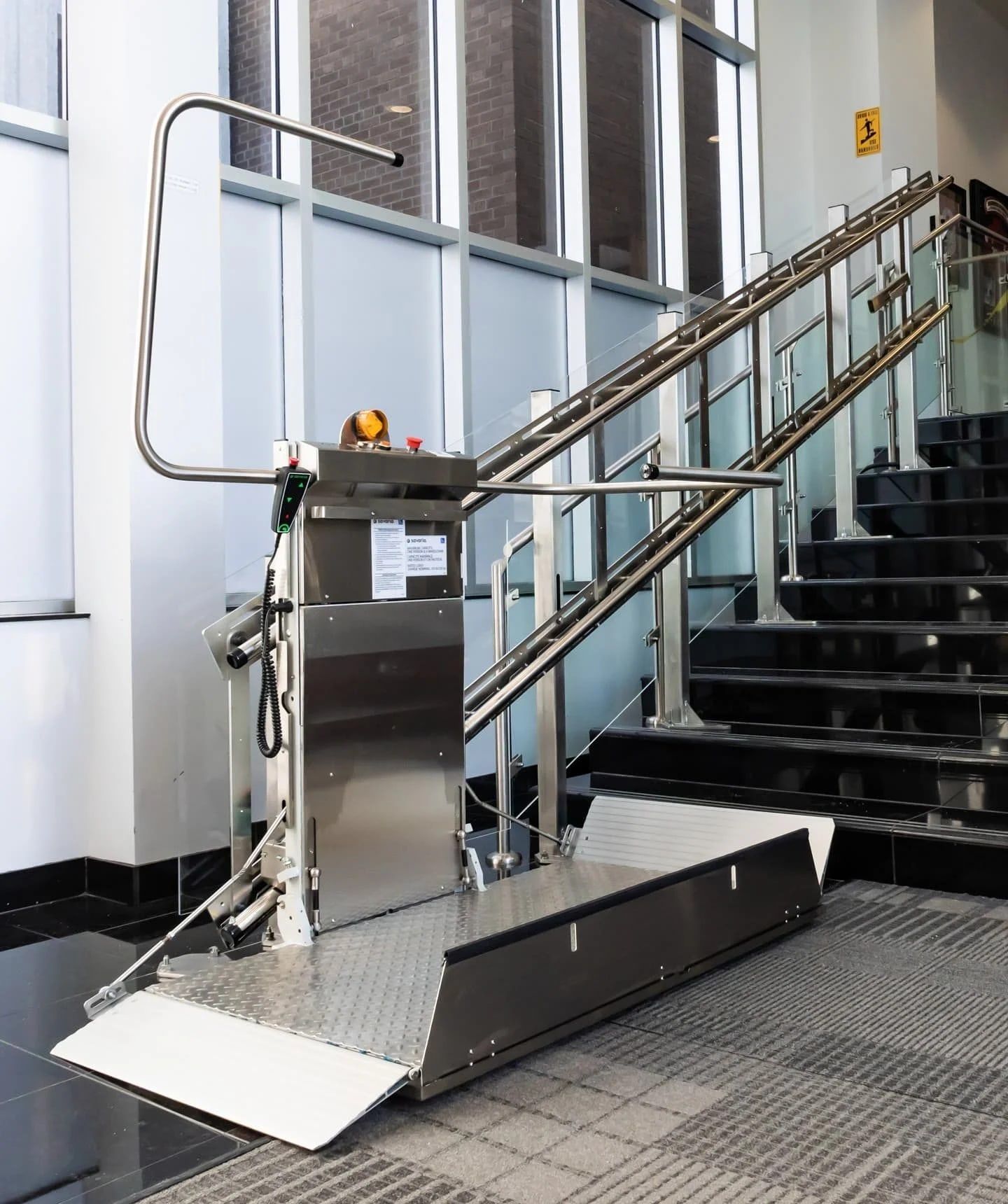
Delta, platform open Delta, parked and folded 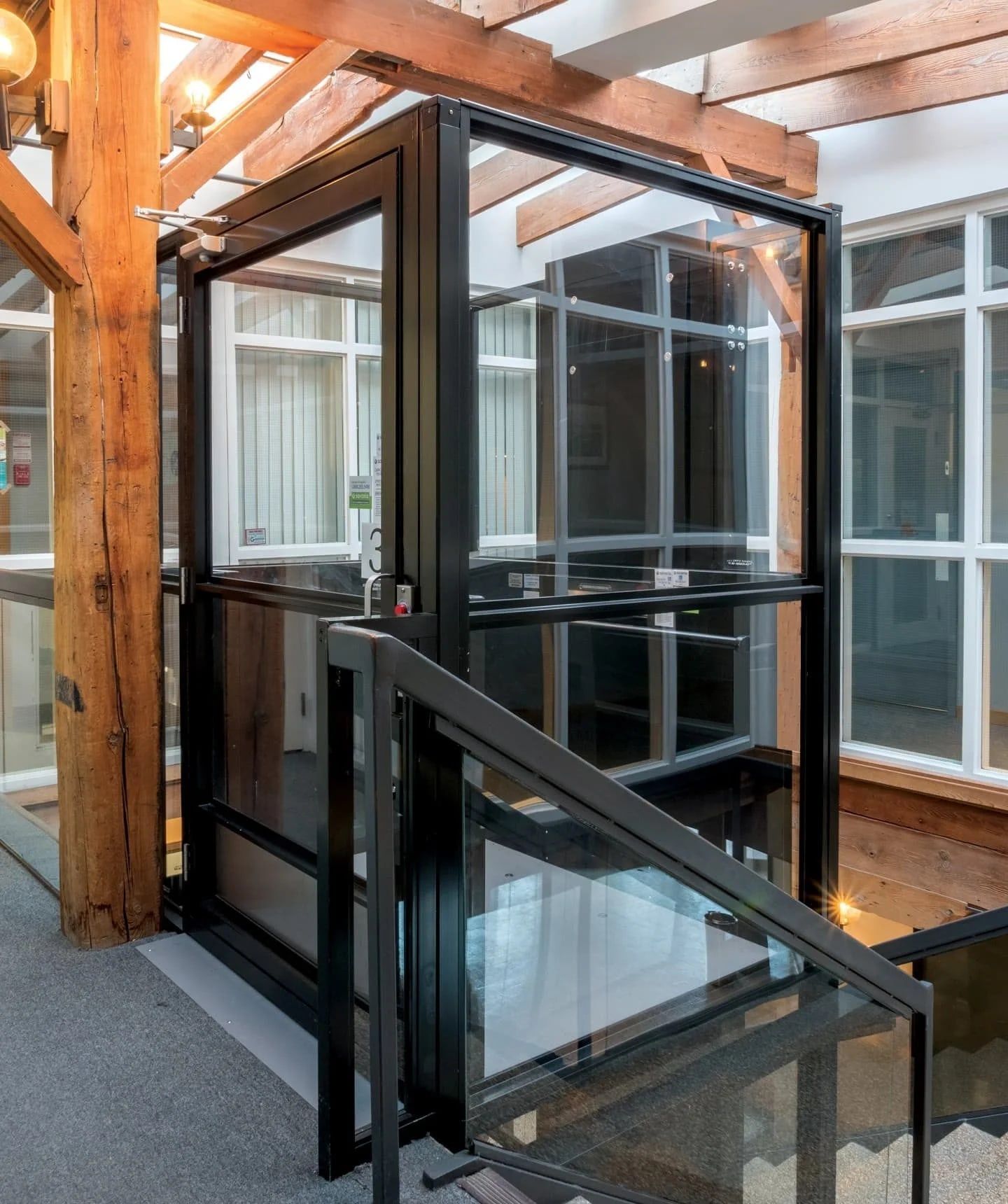
Vertical alternative: enclosed V-1504
Where an inclined lift fits, and where it does not
It fits a straight single flight of constant slope with a wall or posts to carry the rail, enough stair width that the folded lift leaves the code-required clear width for egress, and room at the top and bottom landings to roll on and off. Typical examples: the stair from a church narthex down to the fellowship hall, a school stairwell to a half-level wing, the stair to a second floor office, and a mezzanine stair in a public building.
It does not fit a stair with a landing, a turn, or a winder. The Delta is a straight-stair lift, and we do not currently offer inclined platform lifts for curved or multi-landing staircases. For those, a vertical platform lift in a nearby location, often a Savaria V-1504 in a framed hoistway, is the answer, and we look at both at the site visit. Where only a single rider who can transfer to a seat needs the stair, a commercial stairlift costs far less; the inclined lift is for riders who stay in the chair.
Cost compared with a vertical lift and an elevator
An inclined lift avoids the pad, pit, and hoistway a vertical lift needs, so its site work is mostly the rail supports and a circuit at the charging points. On a long rise it can be the lower cost of the two platform lift options, and both are a fraction of what a LULA or passenger elevator costs, since an elevator needs a hoistway, a deep pit, a machine room, and fire-rated construction. Commercial inclined lifts cost more than their residential versions because of the call stations, the door and gate configuration, and the state permit and inspection. The exact figure depends on rail length, entry type, and options, and we quote it in writing within 24 hours of measuring the stair, with the permit and initial inspection as their own line.
Code and permits for inclined lifts
Inclined platform lifts are covered by ASME A18.1, the same safety standard as vertical platform lifts, which Pennsylvania adopts through the Uniform Construction Code. The ADA Standards allow platform lifts as part of an accessible route in existing buildings and in other specific situations, and require operation without an attendant, with unassisted entry and exit, and reachable controls. In a commercial building that means a Department of Labor and Industry permit with plan review before the order, a local building permit, installation, an acceptance test performed by our technician and witnessed by a certified elevator inspector, and a Certificate of Operation before use, followed by periodic inspections.
The stair-specific questions an inspector asks are the clear width that remains when the lift is folded and the landing space at each end, so we measure those first and show them on the drawings we submit. Read more about permits for a wheelchair lift.
Installation on a working staircase
The rail mounts to the wall or to posts set on the stair, so there is no concrete and no framing beyond blocking in the wall where it is needed. Installation takes two to five days, and the stair can usually stay in use for walking traffic for most of it. We fit the parking points where the lift is least in the way, set the call stations, test the obstruction sensors and the safety edges, and walk the building staff through the fold, the manual lowering, and the emergency stop before the inspection.
We serve churches, schools, offices, and public buildings from Etters across Dauphin, Cumberland, York, Lancaster, Lebanon, Adams, and Franklin counties, and Maryland buildings in Carroll, Frederick, and Washington counties. For vertical lifts and the full range of commercial options, see commercial wheelchair lifts and the pages for churches, schools, businesses, and municipal buildings.
Our own installs
Recent platform lift installations
Our own platform lift installations, residential and commercial, pulled live from the jobs we finished most recently.
Google reviews
What customers say after the install
Pulled live from our Google Business Profile. We show the name the reviewer used, shortened to a first name and initial.
Start at the overview: commercial wheelchair lifts covers the lineup, the code, and the permit process in one place.
Other building types
- Wheelchair lifts for churches
- Wheelchair lifts for schools
- Wheelchair lifts for businesses
- Wheelchair lifts for municipal buildings
Commercial lifts by city
- Commercial wheelchair lifts in Harrisburg, PA
- Commercial wheelchair lifts in Lancaster, PA
- Commercial wheelchair lifts in York, PA
Residential lifts are on the vertical platform lifts page and the full lineup on all platform lifts. Related reading: what a vertical platform lift is, ramp versus platform lift. Or call (717) 219-7976.
Straight answers
Inclined platform lifts: common questions
Can an inclined platform lift go on a staircase with a landing or turn?
No. The Savaria Delta is for straight single flights of constant slope, and we do not currently offer inclined lifts for curved or multi-landing stairs. For those we recommend a vertical platform lift in a nearby location.
How wide does the staircase need to be?
It depends on the platform size and the clear width code requires for egress when the lift is folded. Most commercial stairs of about 44 inches or wider work; we confirm on site and show the dimensions on the permit drawings.
Does the lift block the stairs when nobody is using it?
No. The platform, arms, and ramps fold flat against the wall at the parking point, and a motorized fold is available so staff do not have to do it by hand.
Does it work if the power goes out?
Yes. The Delta runs on batteries that charge at the parking points, so it completes its trip and keeps working through an outage.
Is an inclined lift lower cost than a vertical lift?
Often, on a long rise, because it needs no pad, pit, or hoistway. On a short rise with floor space available, a vertical lift can be simpler. We price the option that fits, and both are far below an elevator.
Planning a lift for a straight staircase?
Call and tell us the rise, where it sits, and what the building is used for. We will come measure and send a written quote within 24 hours with the state permit and inspection included as their own line.