
How Much Does a Vertical Platform Lift Cost?
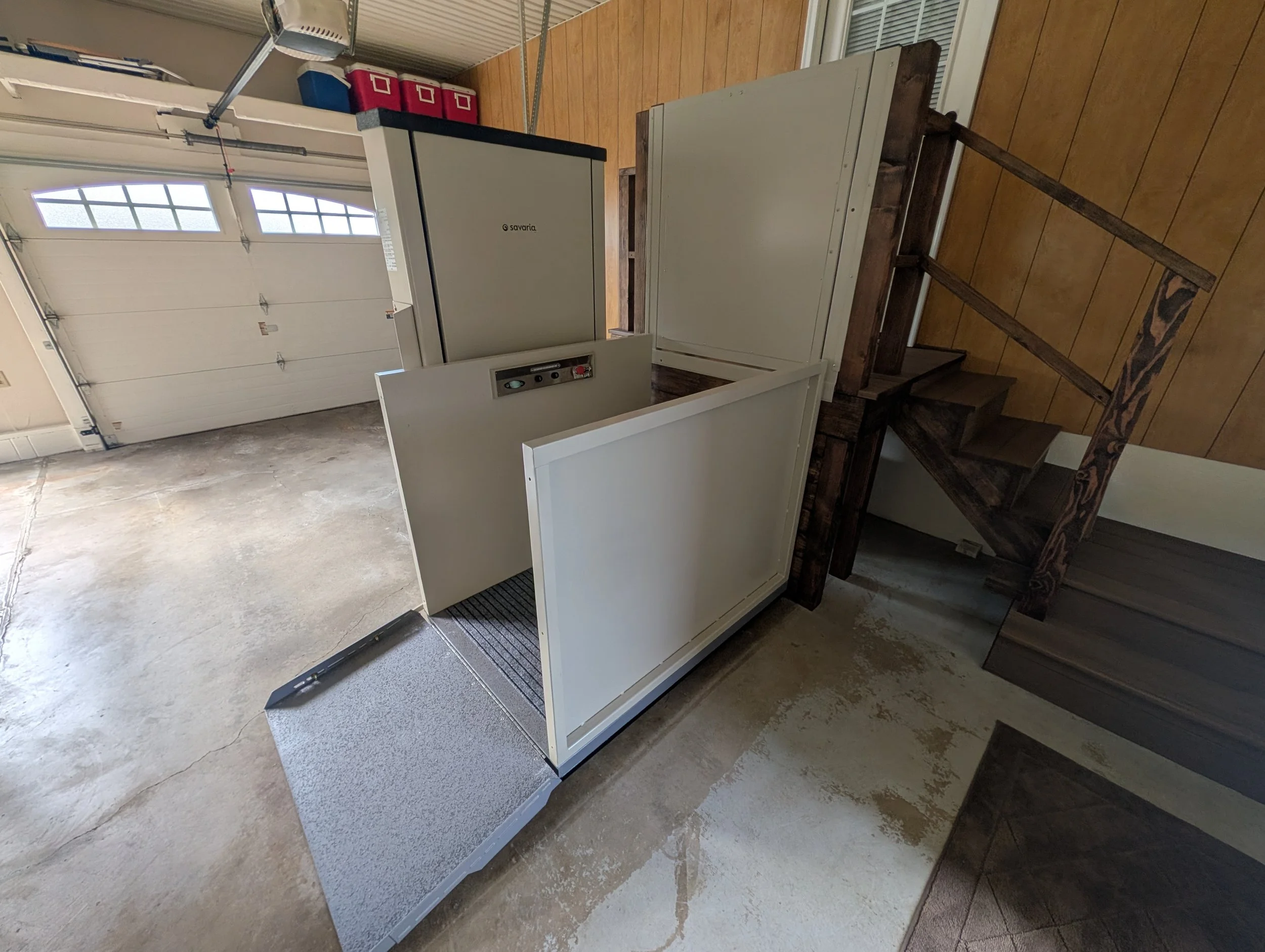
A residential vertical platform lift usually lands somewhere from a few thousand dollars for a short porch rise up into the higher five figures for a tall, enclosed, or outdoor install. Commercial jobs cost quite a bit more than home installs. The honest truth is that the number depends almost entirely on your specific entrance, so the only way to get a real figure is a free in-home measurement.
Below is what actually moves the price, how home and commercial lifts differ, and the funding that can help.
What actually drives the price of a VPL
Two lifts that look nearly identical on paper can carry very different price tags. Here's why:
Travel height. This is the single biggest factor. A lift that rises a couple of feet to clear a porch needs far less material and a simpler mechanism than one climbing a full story. The taller the rise, the more you pay.
Indoor or outdoor. Outdoor units are weather-rated and usually need a poured concrete pad, which adds site work. Indoor lifts often skip that step.
Enclosure. An open platform with low side panels costs less than a fully enclosed hoistway with a top and a door at the upper landing. Some rises and some local codes require the enclosure, which changes the math.
Platform size and capacity. A standard residential platform handles most power chairs and scooters just fine. Ask for an oversized platform or a heavy-duty, higher-capacity model and the price climbs.
Site prep. Concrete work, a dedicated electrical circuit, or grading around the pad all add to the job. A site that's already close to ready keeps the cost down.
Permits and inspection. In Pennsylvania these are a real line on the project, and we'll come back to who handles what below.
So when a neighbor in Littlestown quotes you a number they paid, take it as a loose reference, not a promise. Their porch, their power situation, and their platform choice were theirs, not yours.
Residential vs. commercial: two very different numbers
People often see a scary commercial figure online and assume that's what a home lift costs. It usually isn't. The two are built to different standards.
A residential VPL is sized for a home entrance, a deck, or a split-level landing. It's the affordable, no-major-construction way to get a wheelchair or scooter up a few steps, and it's what most families we help are actually shopping for.
A commercial VPL answers to stricter ADA and code requirements, often needs full enclosures and specific safety features, and typically involves a bigger permitting and inspection process. Churches, small shops, and offices in places like Shamokin or Schuylkill Haven land here. It costs more, but it's still a fraction of what a full commercial elevator would run.
If you're not sure which category you fall into, that's exactly the kind of thing a free consultation sorts out in a few minutes.
When a modular ramp is the cheaper answer
Here's the honest guidance we give every day: a lift is not always the right call. For a rise of roughly 30 inches or less, a modular aluminum ramp is often the faster and more affordable solution. It installs in hours, needs no pit or pad, usually needs no permit, and it can be rented or reconfigured later. Once you're clearing 36 inches or more, or the run of ramp would eat your whole yard, a vertical platform lift starts to make more sense.
We carry both, so we have no reason to push you toward the pricier option. If a ramp solves your problem for less, we'll tell you. For a deeper look at that trade-off, see our post "Wheelchair Ramp vs. Vertical Platform Lift."
Who handles the permits? (and why it matters to your budget)
Permitting is where a lot of homeowners get surprised, so let's be clear about it. On lift and elevator work, Keystone handles the state side in Pennsylvania, including the Department of Labor and Industry filing, the inspection, and the Certificate of Operation. That's a big load off your plate.
If there is a local contractor also involved in the work we typically ask them to pull the local permit. Local requirements and fees vary town to town, so we prepare all the paperwork and documentation you or your contractor need, and the local filing itself stays with you. We'll walk you through exactly what that looks like for your municipality before anything is ordered. If there is no local contractor involved in the project, we can assist with the local permitting directly.
Can Medicare, Medicaid, or the VA help pay?
This is the question that changes the real cost more than any spec sheet, so it's worth knowing where the money actually is.
Medicare. Original Medicare (Parts A and B) generally does not cover a vertical platform lift, because it's treated as a home modification rather than durable medical equipment. Some Medicare Advantage (Part C) plans now offer supplemental home-safety benefits, so it's worth calling your plan and asking directly.
Medicaid. Pennsylvania's Home and Community-Based Services (HCBS) waivers are designed to help people stay in their homes instead of moving to a facility, and home modifications like a lift can qualify. Coverage and caps vary by program and eligibility.
VA. Veterans with a qualifying service-connected condition may tap grants like HISA for smaller home improvements, or the larger Specially Adapted Housing and Special Home Adaptation grants for bigger accessibility projects. These can cover a meaningful share of the cost.
Pennsylvania resources. The Pennsylvania Assistive Technology Foundation (PATF) offers low-interest and even zero-interest loans that can be used for lifts and ramps, and your local Area Agency on Aging can point you toward services in your county. Families in Mifflintown and across Juniata County have used these to bridge the gap.
We're not a benefits office, but we help customers gather the documentation these programs ask for, and we'll happily point you in the right direction.
How to get an honest number
You've probably noticed we haven't quoted a flat price, and that's on purpose. A number pulled off the internet almost always turns out to be wrong for your home once someone measures the actual rise, checks the power, and looks at whether you need an enclosure. We'd rather give you a real figure than a hopeful one.
A Keystone consultation is free, there's no pressure, and you leave with a clear itemized quote you can actually plan around.
Frequently asked questions
Is a vertical platform lift cheaper than a home elevator?
Yes, usually by a wide margin. A VPL skips the shaft, machine room, and heavy construction an elevator needs, so for getting up a few steps or one level it's the far more affordable choice.
Does the price include installation and permits?
A proper quote from us includes installation and the state permitting and inspection we handle. Local permit fees, which vary by town, are separate and stay with the homeowner, though we prepare all the paperwork for you.
How long does installation take?
Once the site and power are ready, many residential VPLs go in within a day or two. The permitting timeline is usually the longer part, and we manage the state piece for you.
Get a free consultation
If you're weighing a vertical platform lift for a home or business anywhere in Pennsylvania or Maryland, let's give you a real number instead of a guess. Keystone Accessibility will come measure your entrance, talk through whether a ramp or a lift fits better, and lay out any funding you may qualify for, all at no cost.
Call us at (717) 219-7976 or reach out through keystoneaccessibility.com to schedule your free consultation. We'll help you find the safe, affordable path to an accessible entrance.
