
How Do I Get a Wheelchair Into a House With Steps?
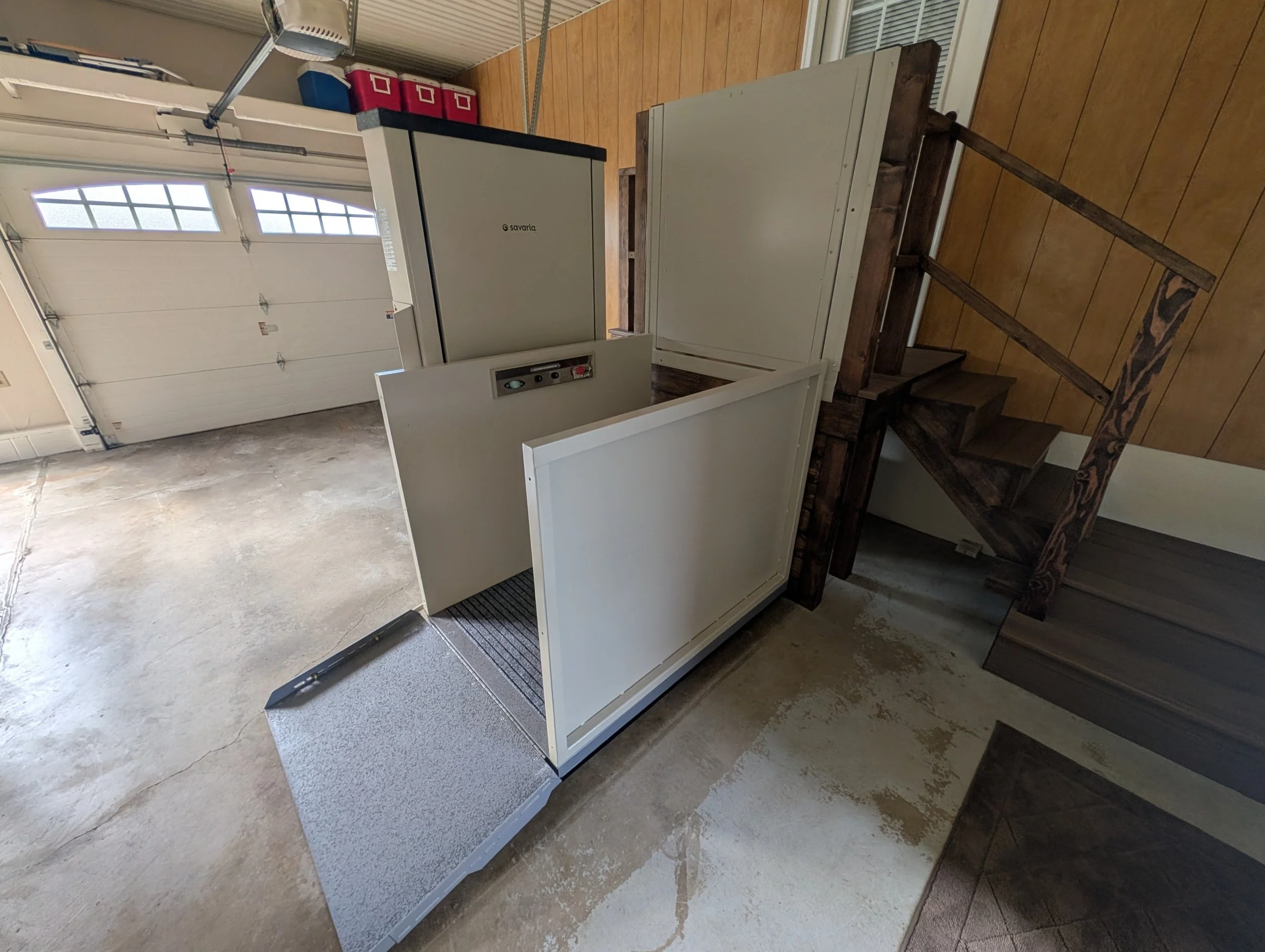
If there are steps at your front door, you have three realistic ways to get a wheelchair in and out safely: a ramp, a vertical platform lift, or a small threshold ramp for a single low step. The right one depends on how many steps you're climbing, how much yard you have to work with, and whether the person can walk a little or is staying in the chair. The good news is that almost every home can be made accessible, and most of these fixes go in fast without tearing up your house.
Start by measuring your rise
Before anything else, measure the total "rise." That's the vertical distance from the ground up to the level of your doorway or porch. One standard step is about 6 to 8 inches, so three steps up to a porch might be around 21 inches, and a full flight to a raised first floor could be 30 inches or more.
That single number drives the whole decision, because ramps need length in proportion to height. The safe slope that lets someone actually push a chair (or roll up in a power chair without tipping) is 1:12. That means for every 1 inch of rise, you need a full foot of ramp. So a 24-inch rise wants about 24 feet of ramp, plus a flat landing at the top and bottom. Once you know your rise, the choice gets a lot clearer.
Option 1: A modular wheelchair ramp
For most homes with a few steps, a ramp is the simplest and most affordable answer. We build with aluminum modular ramp systems, and there are real advantages over a wooden ramp your neighbor hammers together:
They install in hours, not days. The pieces bolt together on site, so a typical entrance ramp often goes in the same day.
No permit headache in most cases. Residential modular ramps usually don't require a building permit the way a permanent poured or framed structure can, though rules vary by municipality.
They won't rot or rust. Aluminum holds up through PA and MD winters for 20 years or more, with no sealing or staining.
They come back apart. If your needs change, the ramp can be reconfigured, moved, or removed, which also makes it a great candidate to rent for a short recovery.
The slope is guaranteed. Built-in landings keep you at that safe 1:12 grade, with handrails on both sides once the rise passes 6 inches.
One thing to keep in mind: ramps take up room. A 30-inch rise at a proper slope needs about 30 feet of run, and code calls for a level rest platform after every 30 inches of climb. We can fold that length into a switchback or L-shape to shrink the footprint, but if you've got a tall porch and a small yard, the ramp can start to eat your whole front lawn. That's usually the point where families we help in Shippensburg or out toward Selinsgrove start asking about a lift.
Option 2: A vertical platform lift
When the rise is high (think five steps or more) or the yard is tight, a vertical platform lift is often the smarter move. Picture a small, open outdoor elevator: the wheelchair rolls straight onto a platform, the user stays seated, and it rises to porch level in a footprint of roughly 5 feet by 5 feet.
Here's why homeowners choose it:
No transfer. The person stays in their chair the whole ride.
Compact. It fits where a 30-foot ramp never could, and can travel up to 14 feet, so even a high entrance or a split-level is no problem.
A lift costs more than a ramp, and it does need power and a small pad. But for a steep entrance it can be the more practical and better-looking solution, and financing plus local funding sources can help with the cost. Just as important, Keystone handles the state permitting and inspection on platform lifts for you, so you're not chasing paperwork on your own.
Option 3: A threshold ramp for a single step
Sometimes the "steps" problem is really just one lip. A single door threshold, a sliding-glass-door track, or one low step under 6 inches doesn't call for a full ramp at all. A threshold ramp is a small, solid wedge that smooths that bump so a chair or walker rolls right over it. It's inexpensive, needs no permit, and sits in place the day it arrives. If your only barrier is that last little rise into the house or out to the patio, this is often all you need.
What about permits?
For most residential ramps, especially portable, threshold, and modular ones, no permit is needed. A permanent, structurally-built ramp is more likely to trigger a local building permit, and requirements vary from one township to the next across Pennsylvania and Maryland. On our lift and elevator installations, Keystone takes care of the state permitting and inspection directly. When a local permit is involved, we prepare all the documentation and hand off the local filing to you or your contractor, since local rules differ everywhere from Pottsville to Westminster. We'll always tell you upfront exactly what your entrance requires.
Which one is right for my house?
Here's the short version:
One low step or a threshold: a threshold ramp.
A few steps with room in the yard: a modular ramp.
A tall entrance, a small lot, or a wheelchair user who can't transfer: a vertical platform lift.
And if you're torn between a ramp and a lift, that's a common crossroads. Our related guides, "Wheelchair Ramp or Platform Lift: Which One Do I Actually Need?" and "How Long of a Wheelchair Ramp Do I Need?", break the comparison down further. If you want to dig into ramp materials, "Wood vs. Aluminum vs. Modular Wheelchair Ramp: Which Is Better?" covers why we build the way we do.
Honestly, the best next step is to have someone measure your actual entrance. Every porch is a little different, and the right answer is the one that fits your steps, your space, and your budget. Families ask this all the time, and there's a good discussion of the emotional side of it if you want to see how others have handled it.
Frequently Asked Questions
How many steps is too many for a ramp?
There's no hard cutoff, but once you're past about five steps (roughly a 30-inch rise or more), the ramp gets long enough that space becomes the real issue. At that point a vertical platform lift usually makes more sense, because its footprint stays the same no matter how high it travels.
Can I get a ramp installed quickly for someone coming home from the hospital?
Yes. Modular aluminum ramps bolt together on site and can often be installed the same day or the next, which is exactly why they're popular for recovery situations. Many families rent one for a few months and return it when it's no longer needed.
Do I need a permit to add a ramp to my home in PA or MD?
Most residential modular, portable, and threshold ramps don't require a permit, while a permanent built structure might. Because it varies by municipality, we confirm the requirement for your specific address before we install and provide any paperwork you'll need.
Will a platform lift work if the power goes out?
Yes. Platform lifts include a battery backup that gives you multiple trips during an outage, so no one is ever stranded at the door.
Get a Free Consultation
Steps at the door shouldn't decide whether someone can come and go from their own home. Keystone Accessibility installs ramps, platform lifts, and threshold solutions across Pennsylvania and Maryland, and we'll help you pick the option that fits your entrance and your budget, not oversell you on the biggest one. Call us for a free, no-pressure consultation and an exact quote. We'll come measure, talk it through, and get you a straight answer.
