
Pneumatic Vacuum vs. Traditional Home Elevator
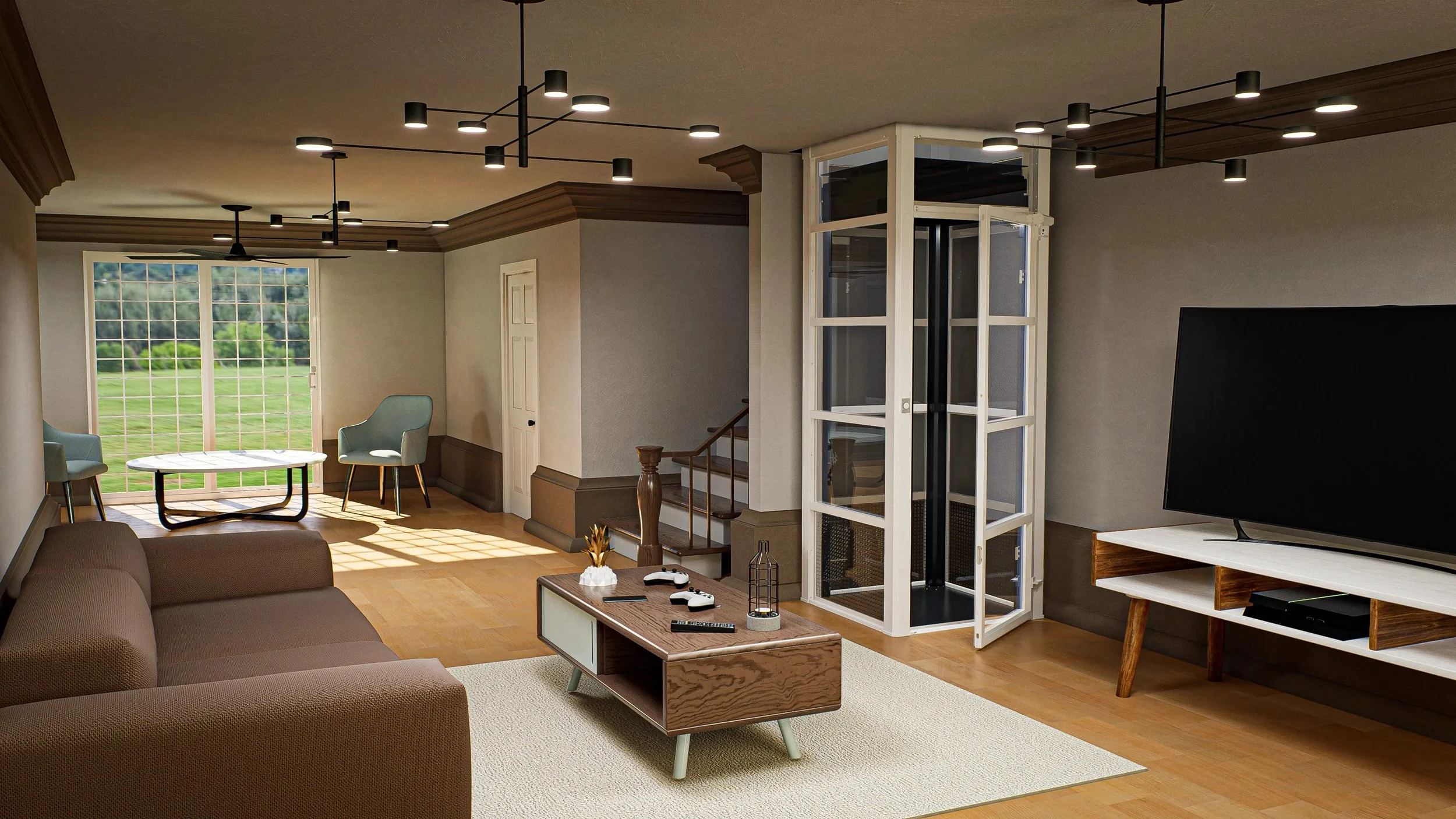
The short answer: a pneumatic vacuum elevator (PVE) lifts the cab by changing the air pressure inside a sealed tube, so it needs no pit, no shaft, and no machine room — while a traditional home elevator uses cables, rails, or a hydraulic piston that require built-out framing and, usually, some construction. Both get you safely between floors. Which one is right for your home comes down to space, how much building you want to do, and who's riding. Here's the full breakdown.
How Each One Actually Works
Pneumatic vacuum elevator. Picture a clear, self-supporting cylinder that stands inside your home. A turbine at the top gently reduces the air pressure above the cab to lift it, then eases pressure back to lower it. The whole system is self-contained — the tube is the structure. That's why there's no pit dug into your basement, no shaft framed through your floors, and no separate machine room tucked away in a closet.
Traditional home elevator. This is the category most people picture: a cab that travels inside a framed shaft, moved by one of a few drive systems:
Cable-driven (traction): counterweights and cables, smooth and quiet.
Hydraulic: a piston pushes the cab up; needs a machine space for the pump and reservoir.
Chain or screw drive: the cab climbs a fixed rail — often the most compact traditional option.
All of these share one thing: they live inside a built shaft, and most need a pit at the bottom (typically several inches to a foot) plus overhead clearance at the top.
Space and Construction: The Biggest Difference
For most homeowners we meet across Central PA, this is the deciding factor. Here's how the two stack up side by side:
Pneumatic vacuum elevator (PVE):
Pit: none required
Machine room: none required
Shaft: none — it's a freestanding tube
Footprint: compact and round
Typical install time: a few days
Passengers: 1–3, depending on the model
Wheelchair use: larger PVE models only
Traditional home elevator:
Pit: usually required
Machine room: often required (hydraulic systems)
Shaft: yes — a framed shaft
Footprint: larger and squared
Typical install time: often weeks, with construction
Passengers: 2–4 or more
Wheelchair use: most models accommodate it
A traditional elevator can carry more people and, in larger cabs, roll a wheelchair straight in — genuinely the better pick for some households. But it asks more of your house. If you don't already have a stacked closet or a spot where a shaft can be framed, you may be looking at cutting into floors, pouring a pit, and finding room for equipment. That construction is where a lot of the time and cost hides.
The PVE flips that. Because it's self-supporting, it drops into an open corner, a stairwell opening, or almost any spot with the floor-to-floor height and a hole cut for the cab to pass through. Installs typically wrap in a few days rather than weeks. For a finished home in Hummelstown or Elizabethtown where nobody wants to gut a hallway, that "no pit, no shaft, no machine room" quality is often the whole ballgame.
What About Cost?
We never quote exact figures on a blog — pricing depends on your home, your floors, the model, and site conditions, and the only honest number is the one from a free in-home assessment. But here's the useful framing:
A traditional elevator's sticker price is only part of the story. The construction — framing the shaft, the pit, the machine space, drywall, electrical, and finishing — can add up to as much as the equipment itself.
A PVE often costs less to install precisely because it skips most of that building. The unit does more of the work, so there's far less to build around it.
Which one is more affordable for your project genuinely depends on the house. In a new build where a shaft is already in the plans, a traditional elevator can pencil out beautifully. In an existing home where every added foot of construction is a headache, the PVE frequently wins on total cost and on peace of mind. We'll lay both options side by side — no pressure, just the real numbers for your situation.
Reliability, Noise, and Feel
A few honest notes, because we'd rather you hear them from us than be surprised later:
Moving parts. A PVE has relatively few, which tends to mean simpler maintenance over the years. Traditional systems have more components, but the technology is time-tested and, done right, extremely durable.
Noise. The PVE's turbine is audible on the way up (it's quieter coming down). Cable and screw-drive traditional elevators are generally very quiet. If whisper-silence matters to you, that's worth weighing.
The ride. Both are smooth. The glass PVE tube gives an open, panoramic feel some people love and others find a little exposed — it's a personal preference, and worth sitting in before you decide.
Power outages. Neither leaves you stranded. A PVE descends safely on a controlled release of air pressure, and traditional units have battery-lowering features. We cover this in more detail in our post on whether you'll get stuck during a power outage.
Which Should You Choose?
A quick rule of thumb from years of installs:
Lean PVE if: your home is already finished, you want minimal construction and a fast install, one to three riders is plenty, and a compact footprint matters.
Lean traditional if: you're building new or already have a shaft, you need to roll a wheelchair straight into a larger cab, you want to carry three or four people, and quietest-possible operation is a priority.
The honest truth is that there's no universally "better" elevator — there's the one that fits your home and your family. Because Keystone installs and services both, we don't have a dog in that fight. We'll walk your home, measure the space, and steer you to the option that actually makes sense, even if it's the less expensive one.
Frequently Asked Questions
Does a pneumatic vacuum elevator need a shaft or pit?
No. It's a self-supporting tube — no pit, no shaft, and no separate machine room. That's the main reason it installs so quickly in existing homes.
Can a vacuum elevator fit a wheelchair?
The larger PVE models can accommodate a wheelchair; the smallest are sized for a seated or standing rider. If wheelchair access is the goal, we'll measure and match you to the right model — or a traditional cab if that's the better fit.
Which is more reliable, pneumatic or traditional?
Both are reliable when properly installed and maintained. A PVE has fewer moving parts; a traditional elevator uses proven, long-lived technology. Regular maintenance matters more to longevity than the drive type — which is exactly what our local service plans are for.
Do you install both types in Pennsylvania and Maryland?
Yes. We install and service pneumatic vacuum elevators and traditional home elevators throughout PA and MD, and we handle the permitting and inspection so you don't have to.
Related Reading
No Major Renovations Needed: Why Homeowners Love PVE Elevators — a closer look at the "no construction" advantage.
Stairlift vs. Home Elevator — if you're still deciding whether an elevator is the right tool at all.
Get a Free Consultation
Trying to decide between a pneumatic vacuum and a traditional home elevator? Let's take the guesswork out of it. Keystone Accessibility is a family-owned, licensed team serving homeowners in Hummelstown, Elizabethtown, Mechanicsburg, Palmyra, and communities across Dauphin, Lancaster, Cumberland, and Lebanon counties — plus all of PA and MD. We'll assess your home, show you both options honestly, and give you a clear quote with no pressure and no hidden fees.
Call (717) 219-7976 or reach us at to schedule your free consultation.
Empowering Independence. Enhancing Lives.
