
Will I Get Stuck in My Home Elevator During a Power Outage?
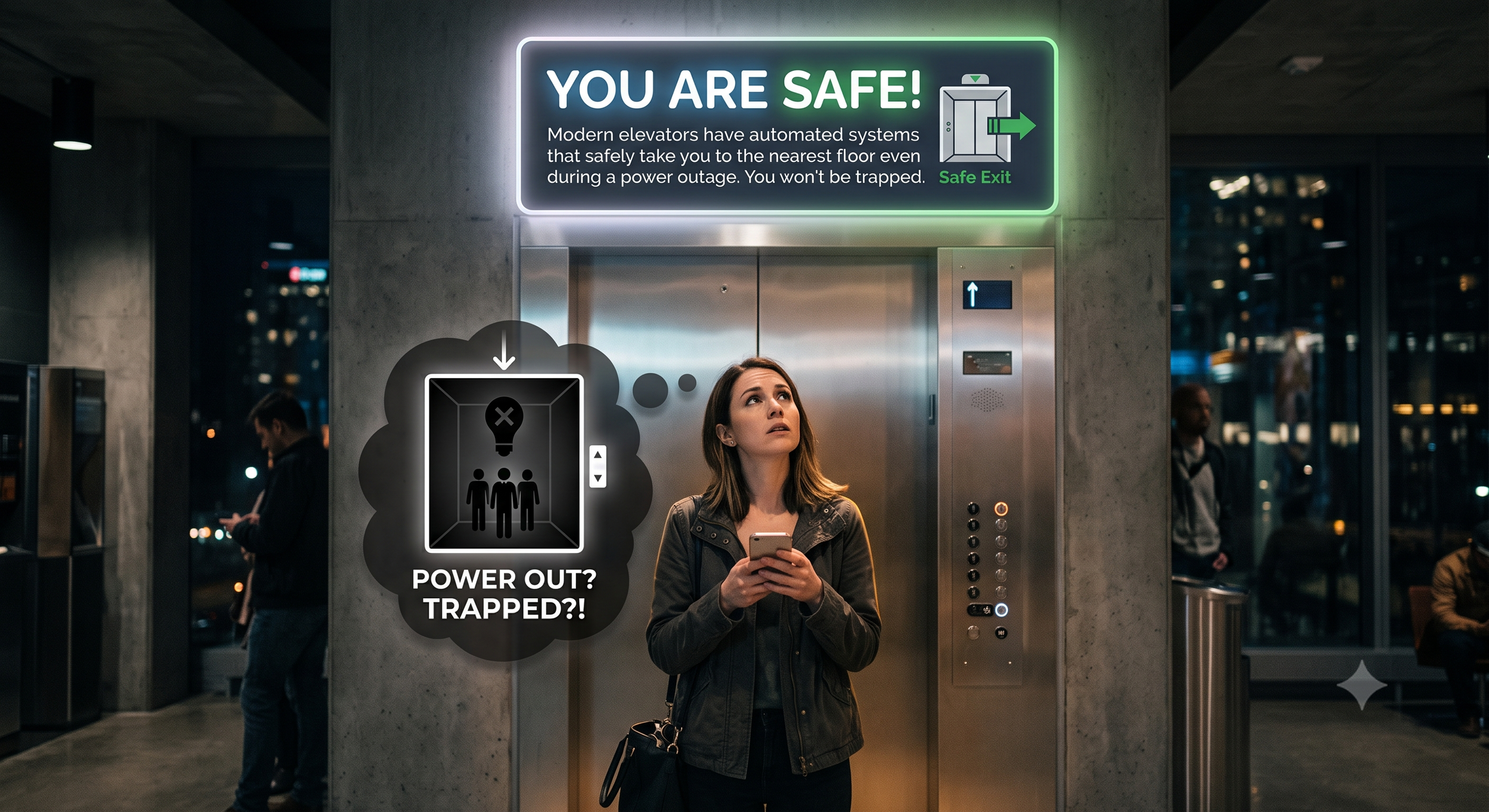
No. A properly designed and maintained home elevator will not trap you when the power goes out. Modern residential elevators are built to bring you safely to a landing and let you step out, not to strand you between floors. How they do it depends on the type of elevator, so let's walk through exactly what happens the moment the lights go dark.
It's one of the most common questions we hear, and it's a fair one. Families ask it all the time before they ever sign anything, and you can . Central Pennsylvania gets its share of summer thunderstorms and winter ice, so the concern is real. Here's the honest, mechanic's-eye answer.
What actually happens when the power cuts out
The short version: your elevator does not free-fall, and it does not freeze in place with you inside it. Every residential elevator we install is engineered to fail safe, which means the safety condition is the default when something goes wrong. Brakes hold. Then a backup process gets you to a floor.
There are two main types of home elevators, and they handle an outage a little differently.
Pneumatic vacuum elevators (PVE): gravity does the work
This is the one that surprises people, in a good way. A pneumatic vacuum elevator lifts the cab by creating suction above it, a gentle vacuum that pulls the car upward. Going up is the only part that uses electricity. Coming down doesn't need power at all, because gravity handles it.
So when the power fails, here's what happens. The system simply releases air back into the tube, the pressure above and below the cab equalizes, and the car settles slowly and smoothly down to the ground floor on its own. No battery required for the descent. No crank, no rescue call, no waiting in the dark hoping someone shows up. The doors unlock at the bottom and you walk out.
A few things worth knowing about a PVE in an outage:
The descent is controlled, never a drop. Air valves regulate the rate, and mechanical brakes and safety locks stand ready if anything else went wrong. Free fall isn't possible by design.
You still get light and air. Most units carry battery-powered cab lighting and ventilation, so even a nighttime outage stays calm and comfortable on the way down.
You can't ride up until power returns. That's the one trade-off. The vacuum needs electricity to lift, so an outage means down-only until the lights come back. For getting to safety, down is exactly the direction you want.
This is a big part of why homeowners across the area love the PVE, and it's one of the reasons we're happy to recommend it for aging in place. If you want the fuller picture of how it compares to a cable or hydraulic unit, our post on pneumatic vacuum versus traditional home elevators breaks it down.
Traditional elevators (cable and hydraulic): automatic battery lowering
A traditional home elevator, the kind that runs on a cable drum or a hydraulic piston, uses a different safeguard called an automatic battery lowering device. It's standard on modern residential units, and it does just what the name says.
The instant power is lost, the backup battery takes over. The elevator makes one slow, controlled trip down to the nearest landing, opens its doors, and then powers down until utility power comes back. You're never left hanging between floors. Electromagnetic brakes prevent any sudden movement, so there's no lurch and no free-fall risk on a well-maintained unit.
The key phrase there is well-maintained. That battery is the whole safety net, and batteries wear out. A backup that hasn't been serviced or replaced on schedule is the single most common reason someone actually does get stuck. Which brings us to the real answer to the worry behind the question.
The honest truth: maintenance is what keeps you safe
Getting trapped in a home elevator is rare, and when it happens it's almost always because a backup system was neglected, not because the design failed. A dead lowering battery, a sensor that drifted out of spec, a brake that never got checked. These are all things a routine service visit catches long before they matter.
That's why we build annual service into how we take care of our customers. A yearly check on the batteries, brakes, valves, sensors, and safety locks is inexpensive peace of mind, and it's the difference between an outage being a non-event and an outage being a scary night. Homeowners we serve in Hanover, York County, and out toward Waynesboro in Franklin County count on that visit, and so should you, no matter who originally installed your lift. We service all makes and models.
Quick comparison: outage behavior by elevator type
Pneumatic vacuum elevator (PVE):
Descends automatically on gravity, no power or battery needed to come down
Battery-backed lighting and ventilation in the cab
Cannot travel up until power is restored
Fewer moving parts, so fewer things to fail
Traditional cable or hydraulic elevator:
Automatic battery lowering brings the cab to a landing, then shuts down
Depends entirely on a healthy, maintained backup battery
Can resume full up-and-down use once power returns
More components, so annual service matters even more
Either way, the goal is the same. You get to a floor, the doors open, and you step out safely. Families in Ephrata over in Lancaster County and up in New Bloomfield in Perry County ask us this question all the time, and the reassurance is real once they understand how the systems actually work.
Frequently asked questions
Can a home elevator free-fall during an outage?
No. Residential elevators use mechanical and electromagnetic brakes plus safety locks that hold the cab in place if anything fails. A pneumatic vacuum elevator lowers on regulated air release and gravity, and free fall isn't mechanically possible.
How long does the backup battery last on a traditional home elevator?
Enough for a controlled trip to a landing, and often several cycles beyond that on a healthy battery. Exact capacity depends on the model. The important thing is keeping that battery tested and replaced on schedule, which is part of a normal annual service.
Do I need a generator for my home elevator?
Usually not. Both pneumatic and traditional home elevators are designed to get you safely to a floor without one. A whole-home generator is a nice convenience if you want uninterrupted up-and-down use during long outages, but it isn't required for safety.
What if the elevator stops between floors?
On a modern, maintained unit it shouldn't, because the backup lowering system moves it to a landing. If you ever felt stuck, every cab has an emergency call or alarm so you can reach someone in the home, and you simply wait for the automatic descent or for help. Never try to force the doors.
Get a free consultation
If a power outage is the thing standing between you and the freedom of a home elevator, let's clear it up in person. We'll walk your home, show you exactly how your options behave when the lights go out, and give you a straight, no-pressure answer. Keystone Accessibility is a family-owned, licensed team serving all of Pennsylvania and Maryland, and we service every make and model we sell.
Call us at (717) 219-7976 or reach out through keystoneaccessibility.com to schedule your free consultation. Let's get you moving through your home with total peace of mind.
